Apple MacBooks are popular in many professional environments because of their performance, portability, display quality, and integration with the macOS ecosystem. However, purchasing MacBooks for an entire team can require a significant investment. For startups, growing businesses, creative agencies, and organisations managing temporary projects, buying multiple premium laptops may not always be the most practical approach.
MacBook rental services offer an alternative. Instead of purchasing devices outright, businesses can access suitable Apple laptops for a defined period and align their technology spending with actual operational requirements.
This approach is particularly relevant for companies that need specialised computing power, expect their workforce to change, or want to avoid maintaining a large inventory of expensive equipment. Understanding how MacBook rentals work and when they make financial sense can help businesses make better technology decisions.
Why Businesses Choose MacBook on Rent Instead of Purchasing Premium Laptops
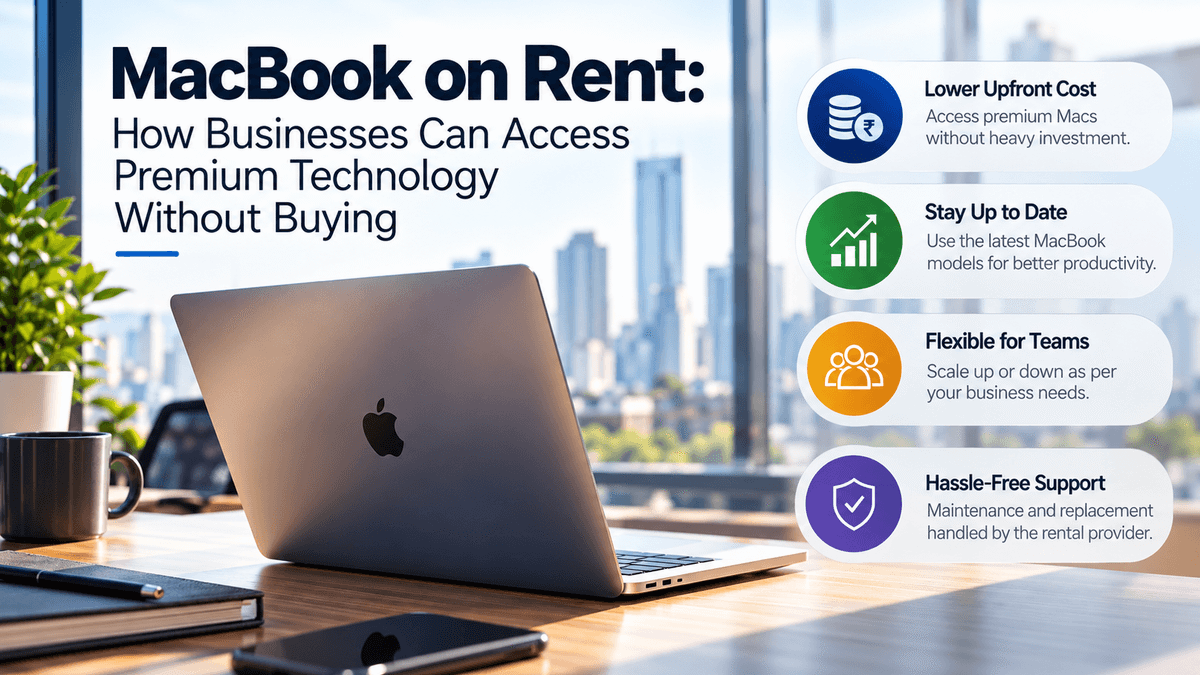
One of the biggest reasons businesses consider MacBook rentals is the cost of purchasing premium Apple hardware. Buying several MacBooks simultaneously can place considerable pressure on an IT budget, especially when the organisation is also investing in recruitment, software, office infrastructure, and business development.
Renting provides an alternative way to access the required devices without paying the full purchase price upfront. This can be useful when a business needs several MacBooks for a defined period or when its future hardware requirements are uncertain.
For example, a creative agency may need additional MacBooks for a major video production project. Purchasing new devices for a project lasting only a few months could leave the company with excess equipment after the assignment ends. Renting allows the agency to arrange devices for the relevant period and return them when they are no longer required, subject to the rental agreement.
Managing IT Budgets and Cash Flow Through MacBook Rental Solutions
Financial flexibility is important for businesses at every stage of growth. Purchasing premium laptops requires a substantial initial outlay, which may limit the capital available for other priorities.
MacBook on rent allows organisations to distribute hardware expenditure over an agreed rental period rather than making the entire purchase payment at once. This can help businesses plan their monthly technology expenses and preserve cash for activities such as hiring, marketing, product development, and customer acquisition.
For startups, conserving capital can be particularly valuable because their operational requirements may change as they acquire new customers or expand their teams. Established businesses may also benefit when they need temporary computing capacity for a specific project or department.
Rental payments can often be planned as operating expenses, subject to the applicable accounting and tax treatment. Businesses should consult their finance teams or professional advisers to understand how a particular agreement should be accounted for.
It is also important to compare the total rental cost with the cost of ownership. A company that requires the same MacBooks continuously for several years may find purchasing more economical, depending on maintenance costs, resale value, and other factors.
Choosing the Right MacBook Air or MacBook Pro for Different Business Workloads
MacBook Air models may suit employees who prioritise portability and efficient everyday performance. Depending on the configuration, they can be appropriate for business communication, office applications, presentations, web-based tools, coding, and many general productivity tasks.
MacBook Pro models may be more suitable for workloads that require greater sustained performance or specialised creative capabilities. These can include video editing, professional design, animation, software development, and other resource-intensive applications.
Developers may need sufficient memory and storage to work with development environments, testing tools, and multiple applications. Creative professionals may require suitable display characteristics, processing power, and storage for large project files. Business executives may prioritise portability, battery performance, and compatibility with presentation equipment.
When arranging rental MacBooks, organisations should identify the required processor generation, memory capacity, storage, display size, and software compatibility. They should also confirm which configurations are available for the intended rental period.
MacBook Rentals for Startups, Software Development Teams, and Technology Companies
MacBook rentals provide startups with a way to access Apple hardware while retaining more capital for core business activities. A small development team, for example, may need MacBooks to build, test, and maintain applications within the macOS ecosystem.
This can be particularly relevant for organisations developing software for Apple platforms, where access to compatible hardware is necessary for certain development and testing workflows.
As the company grows, its requirements may change. It may need additional devices for new developers, temporary contractors, or a project team working towards a launch deadline. Rental arrangements can provide an option for accommodating these changes without immediately purchasing every additional device.
MacBook on Rent for Creative Agencies, Designers, and Video Production Teams
MacBook rentals allow creative teams to access suitable Apple hardware for the duration of an assignment without necessarily expanding their permanent equipment inventory. This can be useful when project demand varies throughout the year.
Video editors may require configurations that can handle their editing software, footage resolution, effects, and export workloads. Graphic designers may prioritise application compatibility, display quality, and memory capacity. Animation and motion graphics professionals may need additional processing resources depending on their workflow.
The appropriate configuration depends on the applications and projects involved. Businesses should also check available storage, external display support, connectivity, and any software licensing requirements.
For creative agencies, the ability to arrange additional devices when project workloads increase can help align technology resources with business demand while keeping longer-term equipment decisions flexible.
Flexible MacBook Rentals for Corporate Training, Events, and Temporary Projects
Not every business needs MacBooks throughout the year. Some organisations require multiple devices for a conference, corporate training programme, product demonstration, workshop, examination, or executive meeting.
Purchasing equipment for a short-duration event can create unnecessary expense and leave the business responsible for storage, maintenance, and asset management after the event concludes.
Corporate MacBook rentals offer an alternative by allowing organisations to arrange devices for the relevant period. This is particularly useful when participants need similar hardware for demonstrations, collaborative activities, application training, or presentation sessions.
Before finalising an event rental, organisers should confirm the device quantity, configuration, delivery schedule, collection arrangements, and technical support requirements. They should also check whether the required applications can be installed and whether the devices are compatible with the event’s display, networking, and security setup.
For larger programmes, planning in advance can help reduce the risk of equipment shortages or last-minute configuration issues. A rental model can therefore provide a practical way to meet temporary technology requirements without maintaining a permanent fleet of premium laptops.
Conclusion
Premium laptops can support business productivity, creative work, software development, and collaboration. However, purchasing MacBooks for every employee or temporary project may not always be the most suitable financial decision.
MacBook rental services provide businesses with an alternative way to access Apple hardware while keeping their technology resources aligned with operational requirements. They can be particularly useful for startups, creative agencies, software development teams, corporate events, training programmes, and organisations with changing workforce needs.
The benefits depend on choosing the right configuration, rental duration, service terms, and support arrangements. Businesses should evaluate the complete cost and operational implications rather than assuming that renting is always cheaper than purchasing. For organisations exploring flexible IT procurement, corporate MacBook rental services can offer a practical way to access premium technology without committing to permanent ownership of every device.