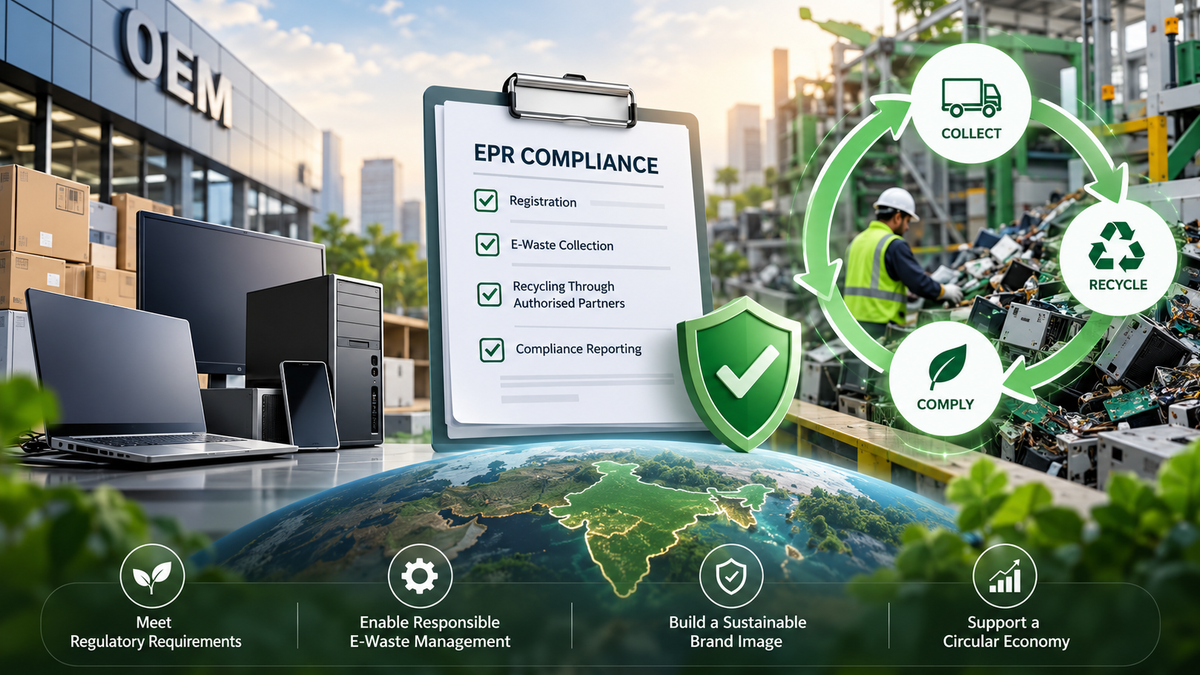
India’s rapid adoption of electronics has created an equally important responsibility for businesses that manufacture, import, sell, or place electrical and electronic equipment in the market.
The E-Waste (Management) Rules, 2022 introduced a structured Extended Producer Responsibility framework for covered electrical and electronic equipment. For Original Equipment Manufacturers (OEMs), understanding this framework is essential.
EPR compliance involves more than collecting discarded electronics. It requires businesses to understand whether their products fall within the applicable categories, determine their obligations, register where required, work with appropriate recycling channels, maintain records and fulfil applicable recycling obligations through the prescribed system.
This guide explains the key aspects of EPR compliance for OEMs in India and highlights how businesses can build a more structured approach to responsible e-waste management.
Why EPR Compliance Matters for OEMs in India
The Indian electronics market continues to expand, and product lifecycles are becoming shorter in many categories. As newer models enter the market, older devices can quickly become obsolete or unsuitable for current requirements.
Without appropriate systems, discarded electronics can enter informal waste channels where valuable materials may be recovered but hazardous components may not be handled under environmentally sound conditions. EPR provides a more organised framework for ensuring that covered e-waste reaches appropriate recycling channels.
For OEMs, compliance also helps establish a documented approach to environmental responsibility. It can support sustainability programmes, responsible supply-chain practices and broader ESG objectives while helping businesses meet regulatory requirements.
Most importantly, EPR should not be treated as a one-time registration exercise. It is an ongoing compliance responsibility that needs proper data, documentation, recycling arrangements and monitoring.
Which Electronics Are Covered Under the E-Waste Rules?
One of the first steps for an OEM is determining whether its products fall within the scope of the applicable rules. Schedule I of the E-Waste (Management) Rules, 2022 lists categories of electrical and electronic equipment covered under the framework.
These include information technology and telecommunication equipment as well as various other electrical and electronic product categories. Personal computers, laptops, notebooks, printers including cartridges, copying equipment and several other IT and telecom products are specifically listed.
An organisation should not assume that its obligation can be determined simply from its general business activity. The actual products, components, consumables, parts and spares placed on the market need to be evaluated against the applicable schedules and definitions.
EPR Registration for OEMs
Registration is a fundamental step in the compliance process. The E-Waste (Management) Rules, 2022 provide for an online EPR framework, and CPCB operates the relevant e-waste EPR portal. Producers, manufacturers, recyclers and refurbishers are among the entities required to register under the framework.
For an OEM, registration should not be approached as a simple form-filling exercise. The information submitted should correspond with the organisation’s actual business activities, product categories and applicable regulatory requirements.
Before registration, businesses should organise their product information, historical sales data, applicable categories and supporting documentation. Maintaining consistency between internal records and regulatory submissions can make future compliance reporting considerably easier.
The Importance of Accurate Product and Sales Data
An OEM may have thousands of products across multiple models, configurations and sales channels. Some products may fall under one category while others may fall under another. Historical sales can also be distributed among dealers, distributors, online marketplaces, institutional customers and direct sales.
Maintaining a centralised database of relevant product information can make EPR calculations and reporting easier. Businesses should ideally be able to identify the product category, quantity placed on the market, applicable period and other information necessary for determining their obligations.
Poor data management can create difficulties later, particularly when compliance requirements need to be reconciled with financial, inventory, sales or logistics records.
Working With Registered E-Waste Recyclers
One of the most important aspects of EPR implementation is ensuring that e-waste reaches appropriate recycling channels.
The regulatory framework requires EPR obligations to be fulfilled through registered recyclers. CPCB specifically states that producers are required to fulfil their EPR obligations through EPR Certificates generated through the prescribed system and linked to registered e-waste recyclers.
OEMs should not select recycling partners solely on the basis of price or collection capacity. They should consider registration status, processing capabilities, documentation, traceability, reporting systems and the ability to support environmentally sound recycling.
A structured recycler relationship can also help businesses maintain evidence of recycling activity and support their broader environmental reporting requirements.
E-Waste Collection and Reverse Logistics
Businesses may also need effective collection and reverse logistics arrangements to move end-of-life products from customers, offices, dealers, service centres or other locations into appropriate recycling channels.
A nationwide electronics brand, for example, may have obsolete products distributed across multiple states. Collecting these devices efficiently requires coordination between customers, distributors, collection partners, logistics providers and recyclers. Reverse logistics can therefore become an important part of an OEM’s e-waste strategy.
A well-designed collection system should make it easy for customers and channel partners to hand over end-of-life equipment while providing sufficient traceability throughout the movement of material.
EPR Compliance and IT Asset Disposal
For OEMs supplying business electronics, EPR compliance often intersects with IT asset disposal. Corporate customers may retire large quantities of laptops, desktops, servers, networking equipment, printers and other electronics at the end of a refresh cycle. These assets can contain reusable components and recoverable materials, while data-bearing devices may also contain sensitive information.
A responsible end-of-life process therefore needs to consider both environmental compliance and information security. Before equipment is recycled, data-bearing assets may require appropriate data sanitisation or destruction procedures. Once data security requirements are addressed, equipment can proceed toward refurbishment, dismantling or recycling according to its condition and applicable processes.
EPR as Part of a Circular Economy Strategy
Electronic products contain materials that can potentially be recovered and returned to productive use. Metals, plastics and other components can enter appropriate recovery streams instead of being lost through uncontrolled disposal.
For OEMs, this means that end-of-life management can become more than a regulatory obligation. It can form part of a broader sustainability strategy involving product lifecycle management, responsible sourcing, refurbishment, reuse and material recovery. A well-designed EPR programme can therefore support both compliance objectives and corporate environmental goals.
The Future of E-Waste Compliance in India
India’s e-waste management framework is becoming increasingly structured, with greater emphasis on formal registration, recycling targets, digital reporting and traceability.
The Ministry of Environment, Forest and Climate Change continues to publish amendments and related regulatory updates, making it important for businesses to monitor the latest requirements rather than relying on outdated compliance assumptions.
For OEMs, this means environmental compliance needs to become part of regular business planning. Companies that establish reliable product data, responsible collection systems, verified recycling partnerships and strong documentation processes will be better positioned to manage their obligations as the regulatory environment develops.
Conclusion
EPR compliance for OEMs is no longer simply about dealing with discarded electronics at the end of their lifecycle. It involves a coordinated system that connects product sales, regulatory registration, recycling obligations, collection, reverse logistics, registered recyclers, EPR Certificates, documentation and responsible end-of-life management.
For OEMs, the most effective approach is to treat EPR as an ongoing operational process rather than a compliance task completed once a year. Accurate data, appropriate product classification, reliable recycling partners, traceable documentation and regular regulatory reviews can help create a stronger compliance programme.
At the same time, responsible e-waste management can contribute to a more circular electronics ecosystem by encouraging reuse, recovery and environmentally sound recycling. As India’s electronics sector continues to expand, businesses that integrate EPR compliance into their product lifecycle strategy will be better prepared not only to meet regulatory expectations but also to demonstrate a more responsible approach to the environmental impact of technology.